5 Records Management Lessons from 7,000 Years
“Records Management exists because human memory fails. It failed 7,000 years ago — and the systems ancient civilisations built to replace memory still protect modern organisations.”
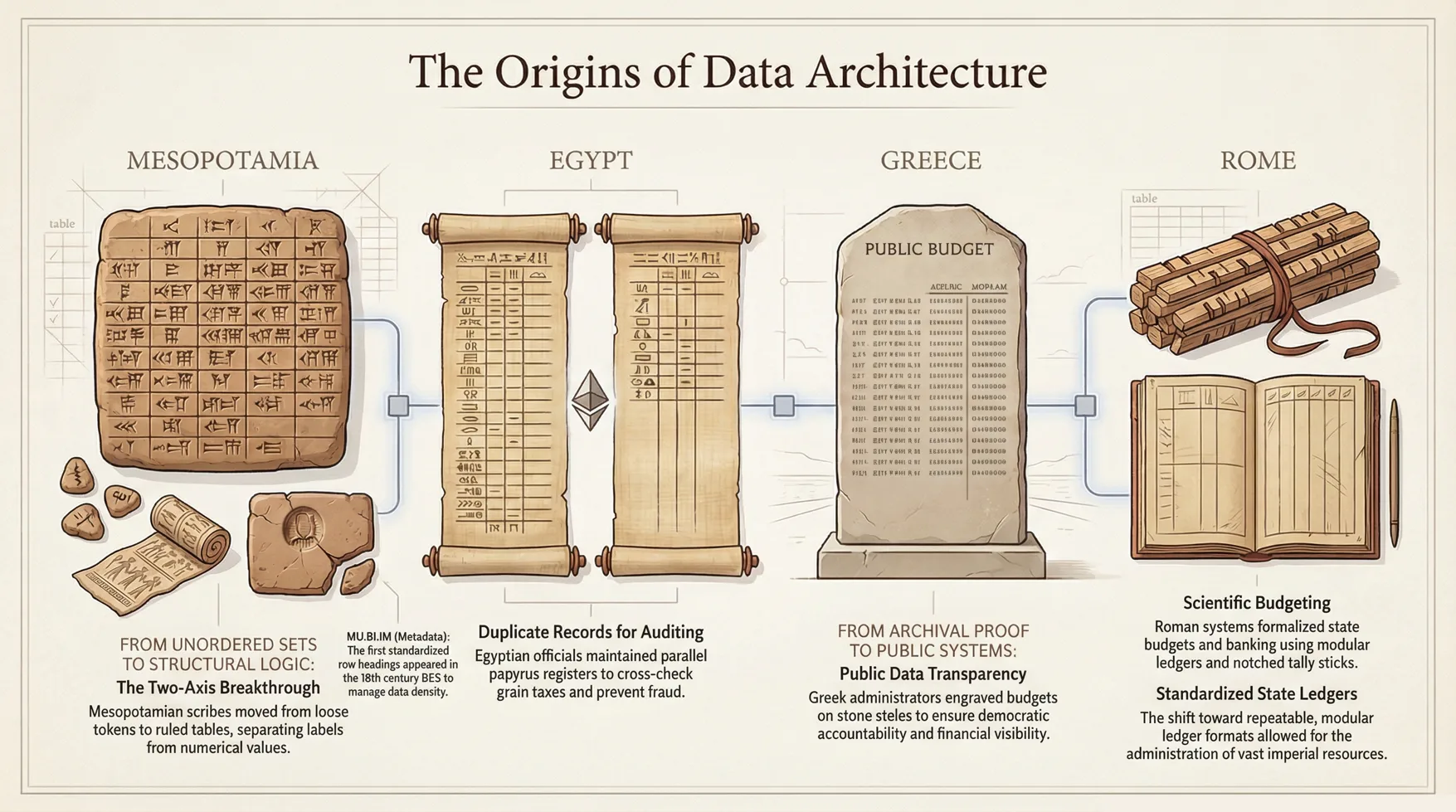
Records Management exists because human memory fails. It failed 7,000 years ago. It still fails today.
The moment humans began pooling resources, trust alone stopped working. Shared wealth without proof collapses fast.
Modern professionals struggle with dashboards and data silos. Ancient administrators struggled with memory. The problem hasn't changed. Only the tools have.
The breaking point of memory
Roughly 7,000 years ago, humans stopped wandering and started settling.
With settlement came taxation. With taxation came shared storage. And the moment grain entered a communal warehouse, someone had to prove how much went in and how much came out.
Memory wasn't enough.
So administrators turned to mud.
Not as symbolism. As hardware.
Clay tablets became the first external storage system. Wet clay, carved with a stylus, then baked into permanent records. Human debt moved out of the brain and into the physical world.
That shift made complex economies possible.
Mesopotamia and the first corporate continuity
In Babylon, clay tablets recorded loans, land deeds, and payments. One well-known example is the banking house of Firm of Egibi.
The Egibi archive was stored in sealed jars. Transactions outlived the people who wrote them. The business survived generations.
That is corporate continuity in its earliest form.
To validate transactions, Babylonians used:
- Cylinder seals rolled across wet clay to create unique signatures
- Nailmarks pressed directly into the tablet as personal confirmation
No vague trust. Physical proof.
When I think about digital signatures today, I picture someone pressing their fingernail into wet clay. Same idea. Different interface.
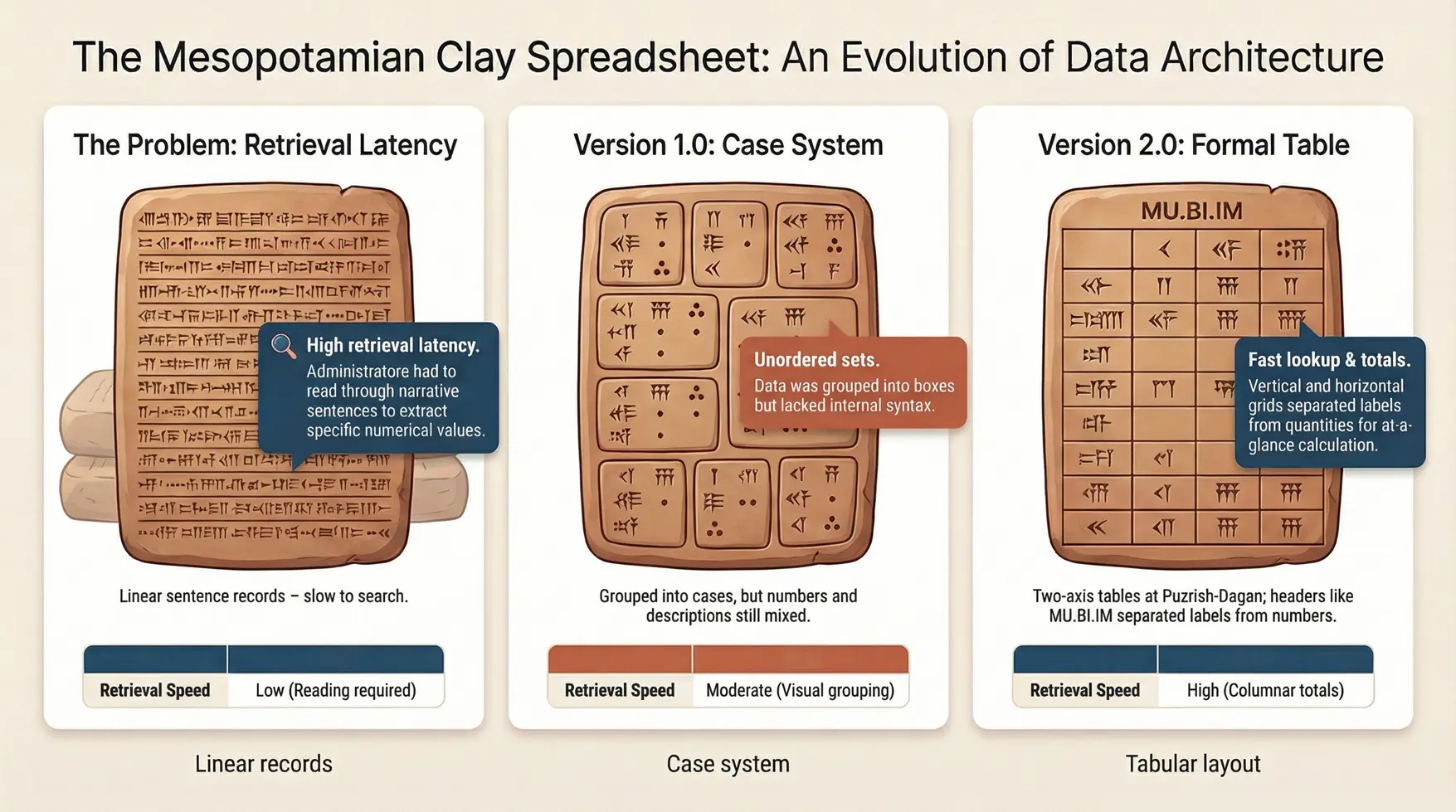
The retrieval problem nobody talks about
As states expanded, a new issue appeared: finding information.
Long narrative entries made it hard to extract numbers quickly. Administrators needed speed.
Around 2028 BCE, scribes at Puzrish-Dagan experimented with structured layouts. Early column formats appeared. Totals were separated from descriptions.
It didn't scale immediately. Change is hard, especially when your entire state depends on the current system working tomorrow.
Later, scribes in Larsa refined multi-column tables. They even used metadata headings like MU.BI.IM ("its name") to organise entries.
This was not storytelling.
This was data architecture.
Egypt and the birth of audit
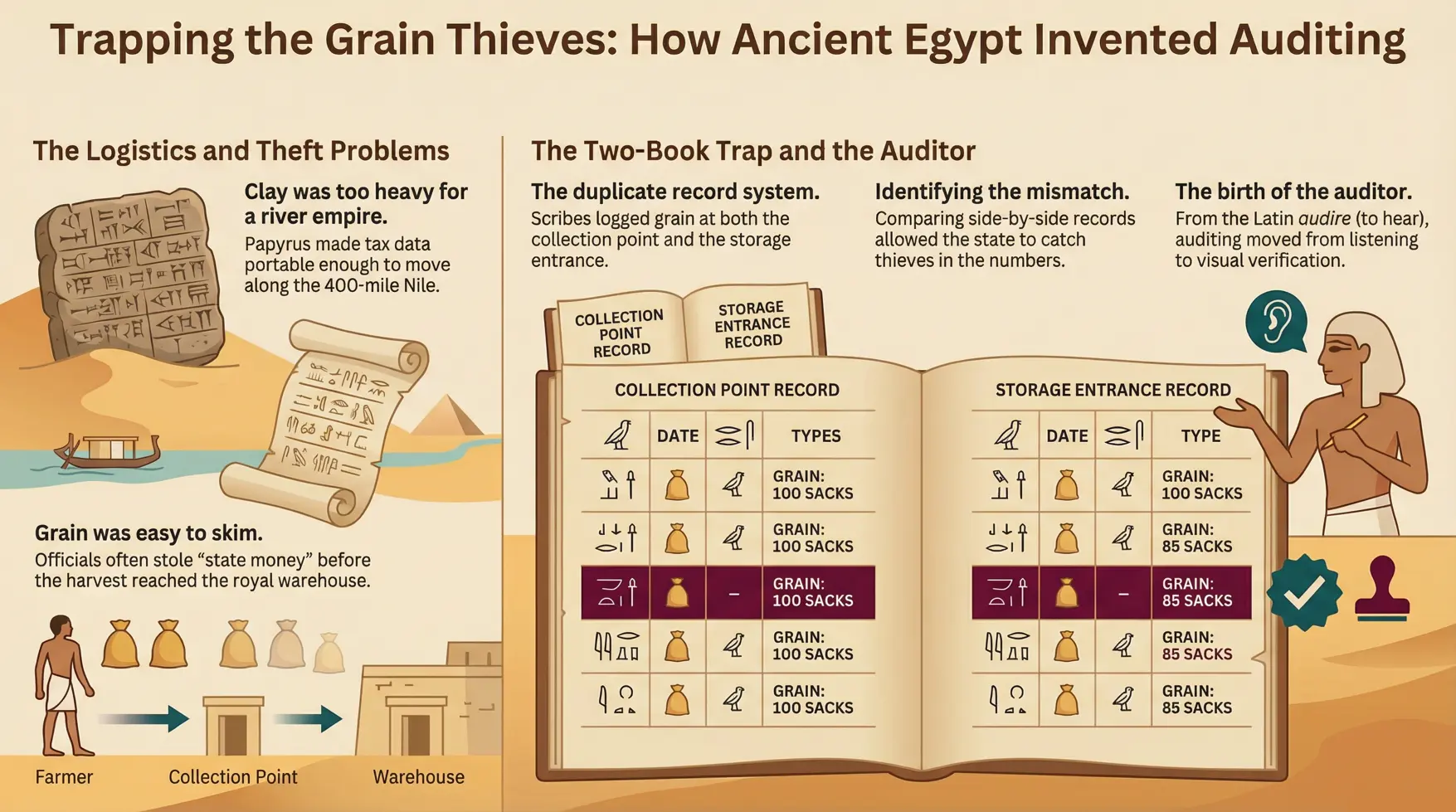
Managing a 400-mile stretch of the Nile required portability. Clay was heavy. Papyrus solved that.
In ancient Egypt, two scribes recorded grain taxes separately. One at entry. One at storage.
Then they compared the books.
That's a duplicate record system. A built-in control.
The word "audit" comes from Latin audire, meaning "to hear." Early audits involved listening to accounts read aloud.
Egypt moved from oral checking to written verification.
Corruption doesn't disappear because people are good. It disappears because systems make theft harder.
Greek transparency and Roman discipline
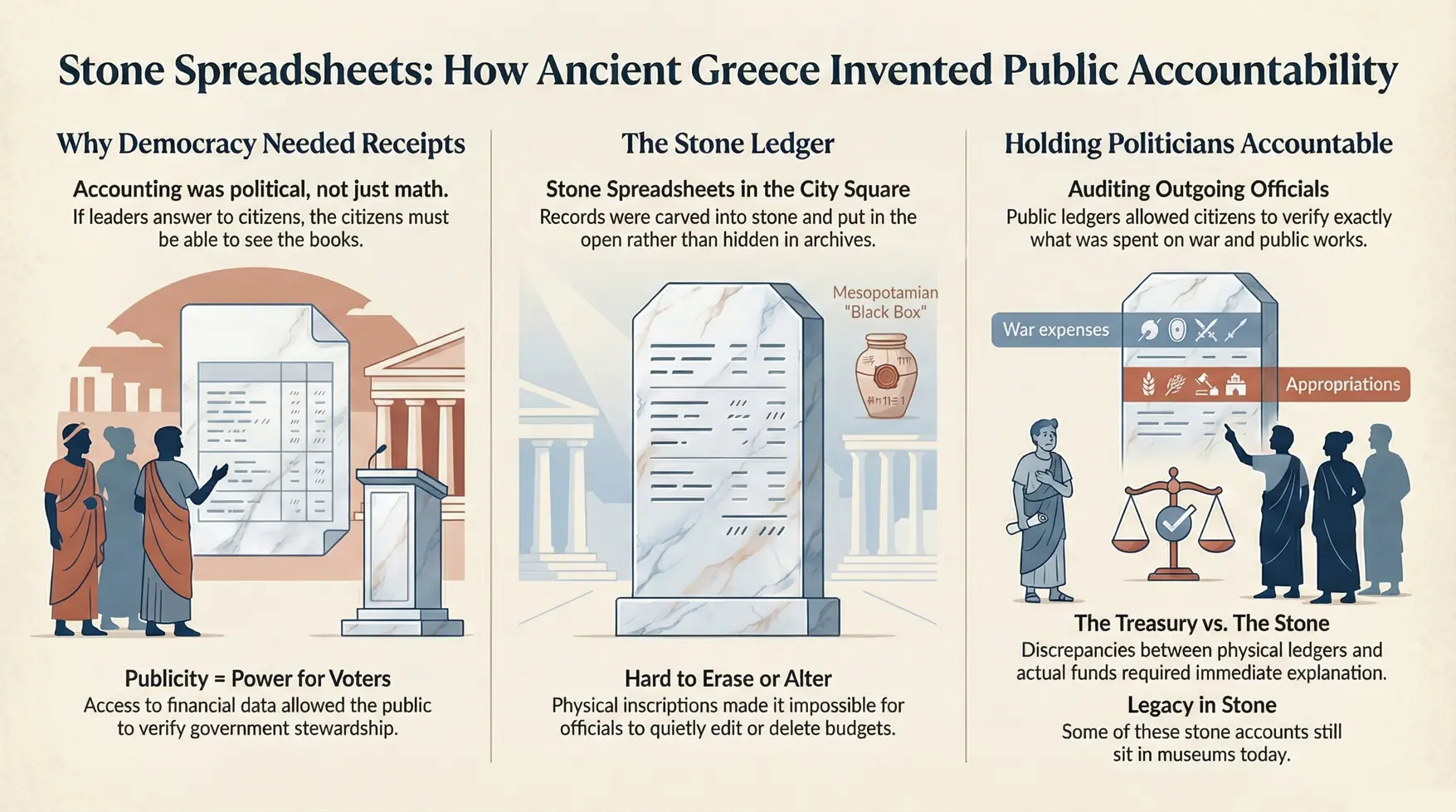
The Greeks believed public money required public visibility. Financial records were engraved in stone and placed in public squares.
Transparency was physical.
The Romans pushed further. They used structured single-entry systems, daily journals, and formalised state budgets.
They understood something modern teams forget:
A ledger is governance.
When the Roman records were destroyed during the Empire's fall, many systems had to be rebuilt centuries later. Institutional memory died with the archives.
That loss still stings when you think about it.
The ancient "supercomputers"
Math has always been the bottleneck.
Before calculators, accountants used finger reckoning and moved pebbles across sand tables.
Then came the Abacus.
A simple frame. Beads on wires. Fast enough to outperform early electronic calculators well into the 20th century.
The abacus enforced what I call the Value Rule:
A record is only as reliable as the accuracy of its inputs.
You can have perfect dashboards. If the inputs are wrong, the output is fiction.
5 insights to improve modern record-keeping
Here's what 7,000 years of bookkeeping teaches us:
1. Externalize memory. If information lives in someone's head, it will fail. Systems beat recollection.
2. Validate at the point of entry. Babylon had nailmarks. Egypt had duplicate entries. Modern teams need controlled inputs.
3. Design for retrieval, not storage. Columns replaced paragraphs for a reason. If you can't find it fast, it doesn't exist operationally.
4. Separate recording from verification. Independent checks prevent silent drift.
5. Protect institutional archives. When records disappear, continuity collapses.
These principles built empires. They still build resilient companies.
Why this tradition still matters
Modern bookkeeping software feels advanced. In reality, it's the latest layer in a 7,000-year experiment.
We moved from memory to clay. From clay to columns. From papyrus to digital ledgers.
The core objective never changed: turn trust into proof.
Every spreadsheet you open is a descendant of a Babylonian nailmark.
So here's the real question:
If ancient civilisations engineered controls to protect shared grain, why do modern organisations still tolerate unclear records and unverifiable numbers?
What part of your record-keeping system still depends too much on trust instead of proof?
Thought this was interesting? This article was originally published on LinkedIn. Join the conversation there:
View & Discuss on LinkedIn