3 Lessons From the Slide Rule Era
“Navigation once killed more sailors than war. A tiny error in latitude. A misread star. A bad multiplication. Ships vanished.”
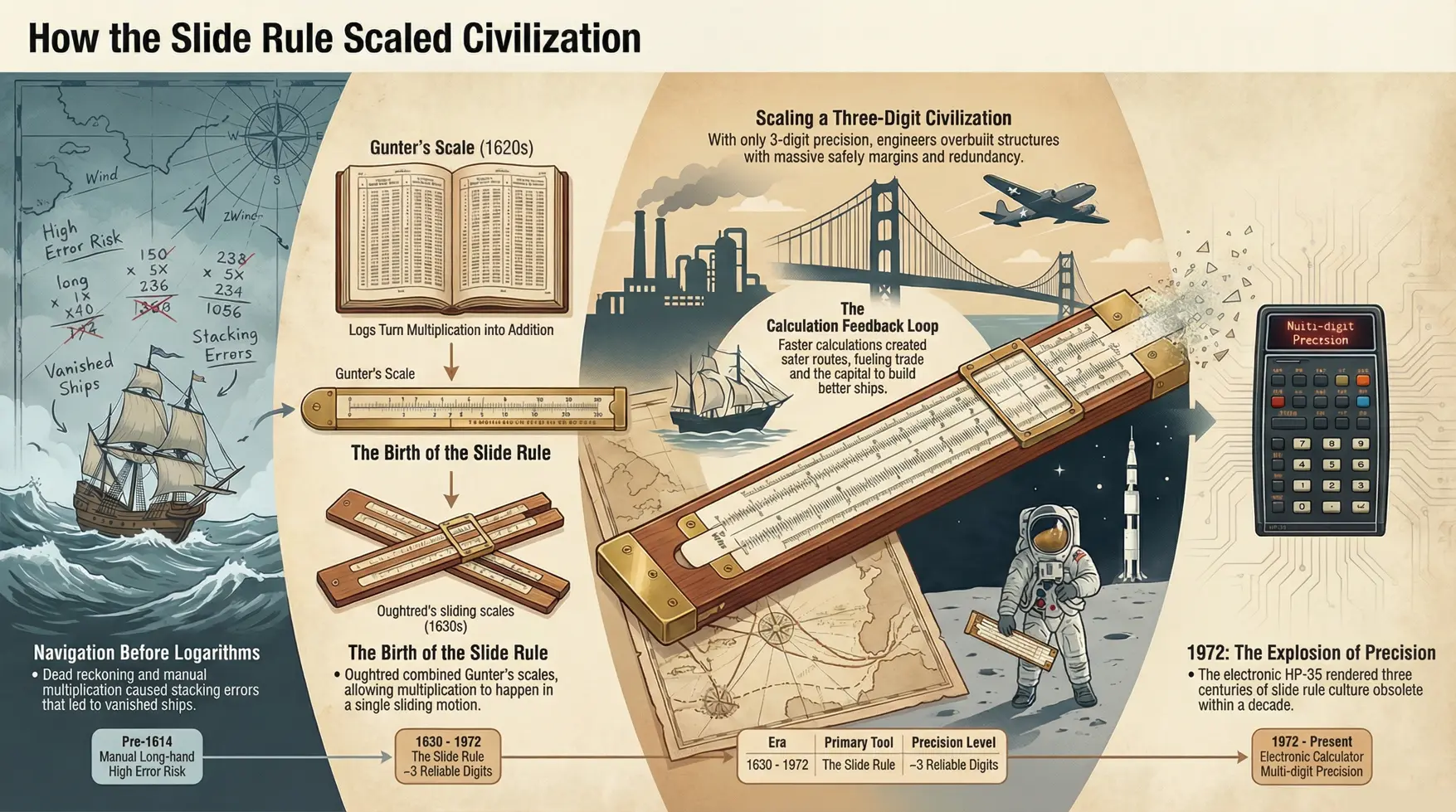
Navigation once killed more sailors than war.
A tiny error in latitude. A misread star. A bad multiplication.
Ships vanished.
Before the 1600s, sailors relied on dead reckoning and rough star sights. Every calculation was done by hand. Multiply. Divide. Recheck. Hope you didn't slip a digit.
Minutes per calculation. Errors stacking quietly.
Then logarithms changed the math.
In 1614, John Napier published tables that turned multiplication into addition. Three years later, Henry Briggs refined them into base ten. The hardest parts of trigonometry suddenly became manageable.
But tables were still paper. Paper was slow.
So Edmund Gunter engraved logarithmic scales onto a straight stick. Sailors used dividers to measure distances on that scale.
Better. Still awkward.
Around 1630, William Oughtred had a simple idea.
Slide two logarithmic scales against each other.
Multiplication happened in one motion.
The slide rule was born.
Speed changed everything
The slide rule cut calculation time from minutes to seconds.
That sounds small. It wasn't.
More accurate positions meant safer routes. Safer routes meant faster voyages. Faster voyages meant more trade.
More trade meant capital. Capital built stronger ships. Stronger ships carried better instruments.
A feedback loop formed.
The slide rule didn't just make math faster. It made expansion practical.
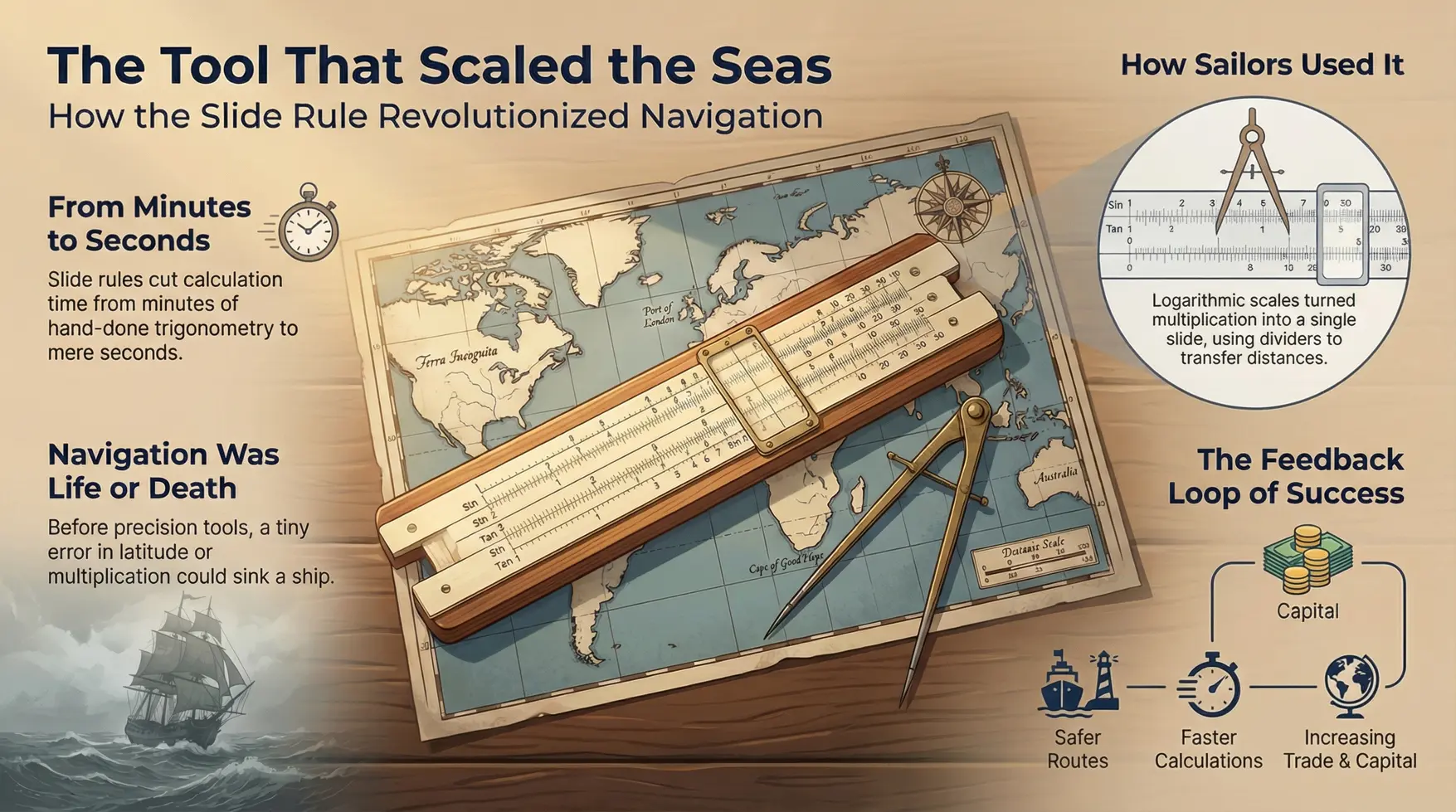
By the late 1600s, serious navigators carried one. Later, engineers adopted it. By the 1800s, it was standard equipment in engineering offices.
And here's what most people miss.
The slide rule only gave three reliable digits.
That constraint shaped how the world was built.
Three-digit civilization
Engineers learned to overbuild.
Extra steel. Extra concrete. Safety margins everywhere.
Small errors hid inside redundancy.
Complex equations stayed rare because they were painful to compute. Designers favored straight lines, symmetry, and models that could be solved quickly.
Innovation moved forward, but cautiously.
The tool quietly influenced ambition.
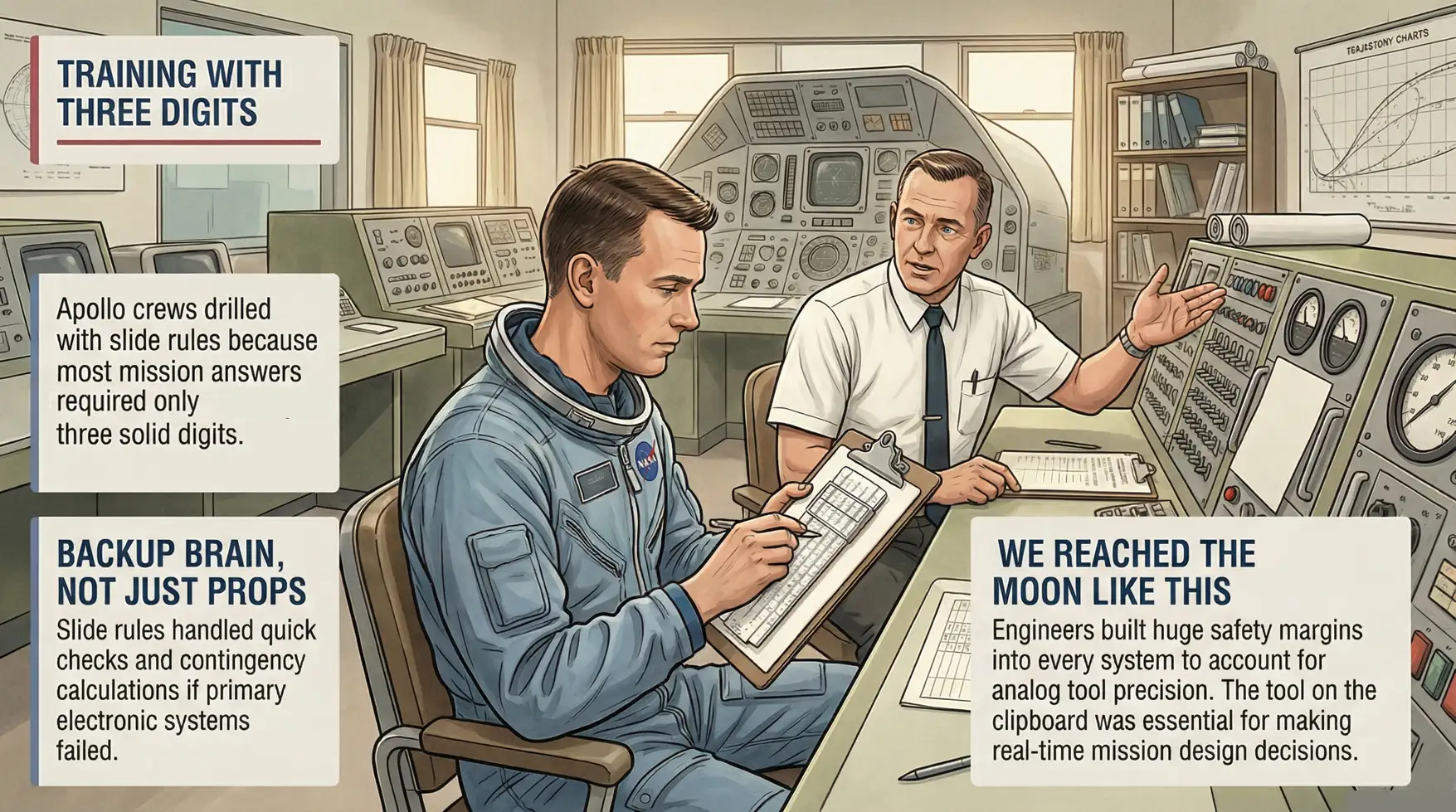
During World War II, slide rules were everywhere. Physicists on the Manhattan Project carried them. Pilots flying the Supermarine Spitfire relied on them. Even NASA astronauts brought Pickett slide rules to the Moon during the Apollo program.
We reached the Moon with three-digit answers.
Think about that.
Then precision exploded
In 1972, HP-35 arrived.
Electronic. Portable. Multi-digit precision.
No estimating decimal points. No squinting at scales.
Engineers switched almost overnight.
By 1980, production had stopped. A tool that dominated for three centuries disappeared in less than a decade.
The uncomfortable question
Did the slide rule limit ambition?
Or did it enforce the discipline that kept civilization stable?
Three-digit precision forced engineers to respect margins. It encouraged conservative design. It rewarded simplicity.
The calculator removed friction.
Suddenly, complexity was cheap.
Today we design with extreme precision and microscopic tolerances. Our models are intricate. Our systems are interdependent.
We rarely ask what constraints once protected us.
That is the real lesson of the slide rule.
Tools do not just help us calculate. They shape what we believe is possible.
And once a better tool appears, the old guardrails disappear with it.
We built bridges, dams, aircraft, and rockets with a slide rule.
Now we build with near-perfect digital precision.
What constraints in today's tools are quietly shaping your industry?
Thought this was interesting? This article was originally published on LinkedIn. Join the conversation there:
View & Discuss on LinkedIn